A Level Maths Formulae: What to Memorise and What's in the Booklet
· Webrich Software · 7 min read
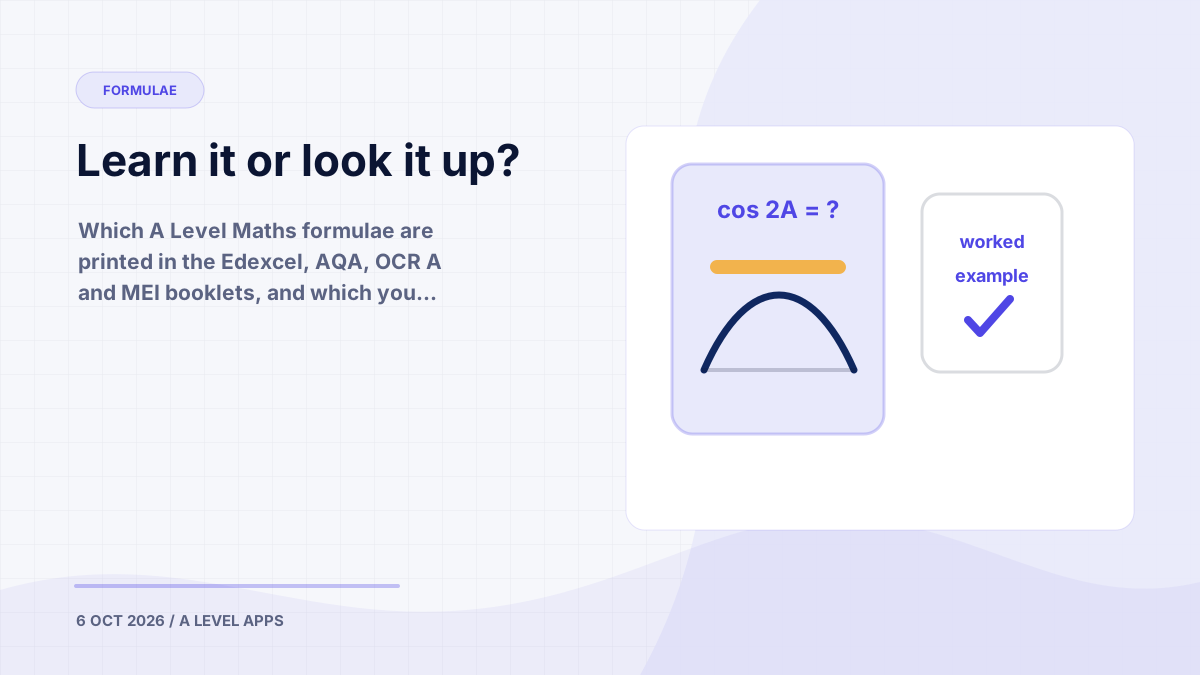
Every A Level Maths paper comes with a formula booklet, and that makes it tempting to assume you can look everything up. You can’t. The booklets are deliberately thin: they print the results that are long or easy to misremember, and leave out anything the specification expects you to know. Getting this wrong costs time in the exam room — flicking through the booklet for a formula that was never there.
This guide sorts the most important A level formulae into three groups: those every board prints, those no board prints, and the awkward middle ground where it depends on your board. The labels come from the formula cards in our A Level Maths app, which were checked against each board’s current booklet. Always look at your own board’s booklet as well — it’s free to download from the board’s website, and getting familiar with its layout is part of revision.
Rule of thumb: if you met it at GCSE, or it’s a one-line definition, assume it isn’t printed. If it’s long, symmetrical and easy to get a sign wrong in, it probably is.
Formulae every board prints
These appear in the Edexcel, AQA, OCR A and MEI booklets. You don’t need to memorise them word for word — but you do need to recognise them instantly and know when to use them.
| Area | Printed formula |
|---|---|
| Series | Arithmetic series Sₙ = ½n(2a + (n − 1)d); geometric series Sₙ = a(1 − rⁿ)/(1 − r); sum to infinity a/(1 − r) for |r| < 1 |
| Binomial | nCr = n!/(r!(n − r)!); the expansion of (a + b)ⁿ; the series for (1 + x)ⁿ for any rational n |
| Trigonometry | sin(A ± B), cos(A ± B), tan(A ± B); small-angle approximations sin θ ≈ θ, cos θ ≈ 1 − θ²/2, tan θ ≈ θ |
| Calculus | Differentiation from first principles; the quotient rule; derivatives of sec x, cosec x and cot x; integration by parts |
| Numerical methods | The trapezium rule; the Newton–Raphson method xₙ₊₁ = xₙ − f(xₙ)/f′(xₙ) |
| Statistics | Binomial P(X = r) and its mean np; the test statistic for a Normal mean Z = (X̄ − μ₀)/(σ/√n) |
| Mechanics | All five suvat equations |
Two things are worth noticing. First, the quotient rule is printed but the product rule and chain rule are not — so you can’t treat “the differentiation rules” as one block. Second, the compound angle formulae are printed but the double angle formulae are not. That’s a useful pairing: put B = A into sin(A + B) = sin A cos B + cos A sin B and you get sin 2A = 2 sin A cos A straight away.
Formulae no board prints — learn these by heart
This is the list that catches students out. None of the four booklets includes any of these.
Algebra and functions
- The quadratic formula x = (−b ± √(b² − 4ac)) / 2a, and the discriminant b² − 4ac (two roots if positive, one repeated root if zero, none if negative).
- Completing the square: x² + bx + c = (x + b/2)² − (b/2)² + c.
- The laws of indices and surd rules, including rationalising a denominator.
- The factor theorem and remainder theorem.
- Partial fractions set-ups, both for distinct and repeated linear factors.
Coordinate geometry
- Gradient, the equation of a line y − y₁ = m(x − x₁), and the perpendicular condition m₁m₂ = −1.
- The equation of a circle (x − a)² + (y − b)² = r², and the circle facts: a tangent is perpendicular to the radius; the perpendicular from the centre bisects a chord.
Trigonometry
- The sine rule, cosine rule and area = ½ab sin C — GCSE knowledge, so not printed.
- Exact values of sin, cos and tan at 30°, 45° and 60° (and π/6, π/4, π/3).
- The identities sin²θ + cos²θ ≡ 1, tan θ ≡ sin θ/cos θ, sec²θ ≡ 1 + tan²θ and cosec²θ ≡ 1 + cot²θ.
- The double angle formulae sin 2A, cos 2A (all three forms) and tan 2A, and the harmonic form a cos θ + b sin θ ≡ R cos(θ − α).
- Radian results: arc length s = rθ and sector area ½r²θ.
Exponentials and logarithms
- The definition of a logarithm and the laws of logarithms.
- Solving aˣ = b using x = ln b / ln a, and the fact that eˣ and ln x are inverses.
Calculus
- The derivative of xⁿ, eᵏˣ, ln x, sin kx and cos kx.
- The chain rule dy/dx = (dy/du)(du/dx) and the product rule d(uv)/dx = u dv/dx + v du/dx.
- Parametric and implicit differentiation, and connected rates of change.
- The basic integrals of xⁿ, 1/x, eᵏˣ, sin kx and cos kx, plus integration by substitution.
- Area between two curves ∫[f(x) − g(x)] dx.
Statistics and mechanics
- The mean, median and the outlier rules (1.5 × IQR beyond the quartiles, or more than 2 standard deviations from the mean).
- Standardising a Normal variable Z = (X − μ)/σ and the Normal approximation to the binomial, with a continuity correction.
- Newton’s laws, F = ma, W = mg, friction F ≤ μR, and moment = force × perpendicular distance.
- All the projectile results, which you should derive from the components u cos α and u sin α rather than memorise as standalone formulae.
Exam tip: practise writing out the unprinted list from memory once a week. If you can produce it on a blank page in ten minutes, you’ll never waste exam time hunting through the booklet.
It depends on your board
This is where knowing your own booklet really matters. The same formula can be printed for one board and absent for another.
| Formula | Printed by |
|---|---|
| Change of base logₐ x = log_b x / log_b a | Edexcel only |
| aˣ = eˣ ˡⁿ ᵃ | Edexcel only |
| Sum-to-product (factor) formulae | Edexcel only |
| Integrals of sec²kx, tan kx, cot kx, sec kx and cosec kx | Edexcel only |
| Derivative of tan kx | Edexcel, OCR A and MEI — not AQA |
| ∫ f′(x)/f(x) dx = ln|f(x)| + c | AQA, OCR A and MEI — not Edexcel |
| ∫ f′(x)[f(x)]ⁿ dx | OCR A and MEI only |
| Variance of a binomial np(1 − p) | AQA, Edexcel and OCR A — not MEI |
| Conditional probability P(A | B) = P(A ∩ B)/P(B) | OCR A and MEI only |
| Interquartile range, complement rule, independence test | Edexcel only |
| Sxx = Σx² − (Σx)²/n | Edexcel and MEI |
| suvat in vector form | AQA, OCR A and MEI — not Edexcel |
A few patterns stand out. Edexcel’s booklet is the most generous with integrals of trigonometric functions. OCR A and MEI print some of the reverse-chain-rule integrals that Edexcel leaves out. And the statistics pages differ in small ways that are easy to miss, such as which variance formula is shown.
AS students: check again
If you’re sitting AS rather than the full A level, be careful. The AS booklets for Edexcel and AQA match the A level booklet for AS content, but OCR A and MEI AS papers come with a much shorter formula page. For example, the addition rule P(A ∪ B) = P(A) + P(B) − P(A ∩ B) is printed for Edexcel and AQA AS candidates, but an OCR A or MEI AS candidate needs to know it.
How to learn the “learn this” list
- Group by derivation, not by chapter. Double angle formulae come from compound angles; sec²θ = 1 + tan²θ comes from dividing sin²θ + cos²θ = 1 by cos²θ. Learning the chain of reasoning means one memory gives you several formulae.
- Use them, don’t just read them. A formula you’ve applied in ten questions sticks far better than one you’ve copied out ten times. Our free practice on exponential functions and differentiation from first principles is a good place to start.
- Test from cold. Cover the formula, write it, check it. Spaced repetition — a little every few days — beats one long session.
- Know the conditions. The sum to infinity needs |r| < 1; the binomial series for rational n needs |x| < 1; suvat needs constant acceleration. Examiners love asking why a formula is valid.
See it for your board
Our A Level Maths formulae page lets you pick your exam board and see the “In your booklet” and “Learn this” label on every formula card. In the app, all 233 cards follow the board and course you choose, with rearrangements, what each letter means and the common mistakes for each one.
Once you know exactly what you need to learn, the booklet becomes a tool rather than a crutch — and that’s worth marks on every paper.
Frequently asked questions
Is the quadratic formula in the A Level Maths formula booklet?
No. None of the four boards prints the quadratic formula, the laws of logarithms, the chain rule or the product rule — they are all assumed knowledge from GCSE or AS.
Do I get the double angle formulae in the exam?
No board prints sin 2A, cos 2A or tan 2A. Every board prints the compound angle formulae sin(A ± B), cos(A ± B) and tan(A ± B), so if you forget a double angle formula you can rebuild it by putting B = A.
Are the suvat equations given?
Yes. All four boards print the five constant-acceleration equations. You still need to know when they apply — only when acceleration is constant.