A Year 13 A Level Maths Revision Plan: September to June
· Webrich Software · 6 min read
Year 13 Maths is a juggling act. You’re learning the hardest content of the course — Year 2 Pure, plus the second half of Statistics and Mechanics — while the Year 1 material you learnt last year slowly fades. And the summer exams test all of it, often in the same question.
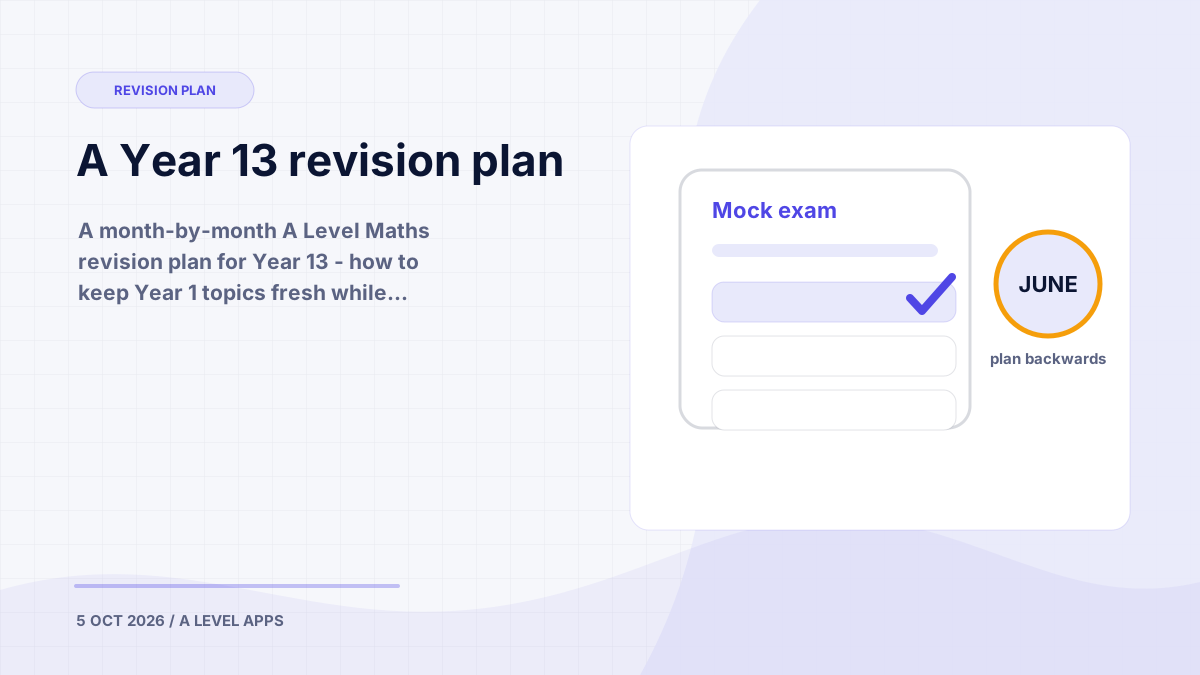
The students who do best don’t leave revision until Easter. They build a small, steady routine from September that keeps old topics alive, then ramp up in the spring. This plan shows one way to do that. Adapt the timings to your school’s teaching order and mock dates.
The principles
Before the calendar, four ideas that make any plan work:
- Little and often beats long and rare. Three focused 30-minute sessions a week from September do more than a panicked fortnight in May.
- Mix old and new. Every week, practise something you’re learning now and something from Year 1. Interleaving topics is harder than blocking them, and that’s why it works.
- Test, don’t reread. Answering questions — and checking why you got them wrong — beats rereading notes or copying them out.
- Revise for your board. Your papers, Large Data Set and formula booklet are specific to Edexcel, AQA, OCR A or MEI. See how the boards differ.
September and October: build the habit
You’re starting Year 2 content in lessons. Outside lessons, set up the routine you’ll keep all year.
- Make a topic list. Use your specification or our topics page (filter it to your board) and mark each subtopic red, amber or green.
- Start a “mistakes log”. Every question you get wrong goes in it, with one line on why. This becomes your most valuable revision document.
- Secure the Year 1 foundations that Year 2 relies on: algebra and functions, the laws of indices and logarithms, trigonometry, and differentiation. Good places to check yourself, free:
Weekly target: two short sessions on this week’s lesson content, one on a red Year 1 topic.
November and December: keep pace and consolidate
Year 2 topics are arriving quickly — functions, sequences and series, further trigonometry, the start of further calculus.
- Review each new topic within a week of meeting it in class. Read the notes, then answer questions without looking.
- Make a running list of formulae you must learn. Many key Year 2 results — the double angle formulae, the chain and product rules, the derivatives of ln x and sin x — aren’t in any formula booklet. Our formulae guide has the full list, and the formulae page labels each card for your board.
- Before the winter break, do one timed section of a past paper for each area — Pure, Statistics and Mechanics — to see where you stand.
Over the break: take real time off, but do a few short sessions on your two weakest Year 1 topics so they don’t drift further.
January and February: mocks and gaps
Many schools hold Year 13 mocks in January. Treat them as a diagnosis, not a verdict.
- Go through your mock paper question by question. For every lost mark, decide: did I not know it, misread it, or make a slip? Each kind needs a different fix.
- Turn the reds amber. Spend most of your time on the topics your mock exposed, using notes first, then practice questions on that subtopic.
- Start the Large Data Set properly if you haven’t already. Open the spreadsheet, learn the variables, codes and quirks. Our Large Data Set guide covers what each board uses.
- Keep Year 2 content moving. Further calculus — the chain, product and quotient rules, integration by parts and substitution, differential equations — underpins a large share of the Pure marks.
Weekly target: three or four sessions; at least one is mixed questions from across the course.
March and April: full coverage and past papers
Teaching should be finishing. This is when revision becomes the main event.
- Work through every topic once in a structured way: notes, then questions, then mistakes log. Aim to have touched every subtopic on your list by the end of the Easter holidays.
- Start full past papers under timed conditions — one a week at first, then two. Mark them honestly with the mark scheme.
- Practise the applied papers in their real format. On Edexcel, Statistics and Mechanics share one paper; on AQA, OCR A and MEI, Pure questions sit alongside them. Get used to switching.
- Revisit the formula booklet for your board. Know where everything is so you’re not hunting for it in the exam.
Easter holidays: a realistic target is a past paper every other day plus topic practice on the days in between — with proper rest days built in.
May and June: sharpen and stay calm
- Mostly past papers and mixed practice now. New learning has diminishing returns; exam technique has big ones.
- Read your mistakes log weekly. It’s a personal list of the exact errors you’re likely to repeat.
- Rehearse “show that” and proof questions, where clear presentation earns marks.
- Between papers, review the next paper’s areas: if Paper 3 is Statistics and Mechanics, spend the gap there.
- Sleep. Seriously — tired students make arithmetic slips that cost more marks than any last-minute topic could gain.
Exam tip: in every paper, write down what you’re doing. Method marks are generous at A level; an answer with clear working that goes wrong at the end can still score most of the marks.
If you’re starting late
If it’s already spring and you haven’t started, don’t try to follow the plan from September. Instead:
- Do one full past paper for each paper you’ll sit, under timed conditions, to find your biggest gaps.
- Rank topics by marks lost, not by how much you dislike them.
- Spend most of your time on the top five, using notes then questions, and do a timed paper every week.
A focused six weeks can still make a real difference.
A sample week in February
| Day | Session (30–45 minutes) |
|---|---|
| Monday | Notes and questions on this week’s lesson topic |
| Tuesday | — |
| Wednesday | A red topic from the mock: notes, then 15 questions |
| Thursday | — |
| Friday | Large Data Set: one variable or code a week, with practice questions |
| Saturday | Mixed questions or a timed past-paper section |
| Sunday | Ten minutes on the mistakes log and the “learn this” formula list |
Using the app alongside your plan
The A Level Maths app is built for exactly this kind of short, regular session. Pick your board and course and you get:
- revision notes with worked examples for every subtopic
- exam-style questions with an explanation of every answer, right and wrong
- formula cards labelled “Learn this” or “In your booklet” for your board
- a mock test for each area — Pure Year 1, Pure Year 2, Statistics, Mechanics and the Large Data Set — plus a full mixed mock, with your history so you can see your progress
You can try it free on this site first: every topic in our topics list has revision notes, and those marked Free have practice questions too. Pick one red topic tonight, and you’ve started.