A Level Maths Quadratics: Completing the Square, the Discriminant and Graphs
· Webrich Software · 8 min read
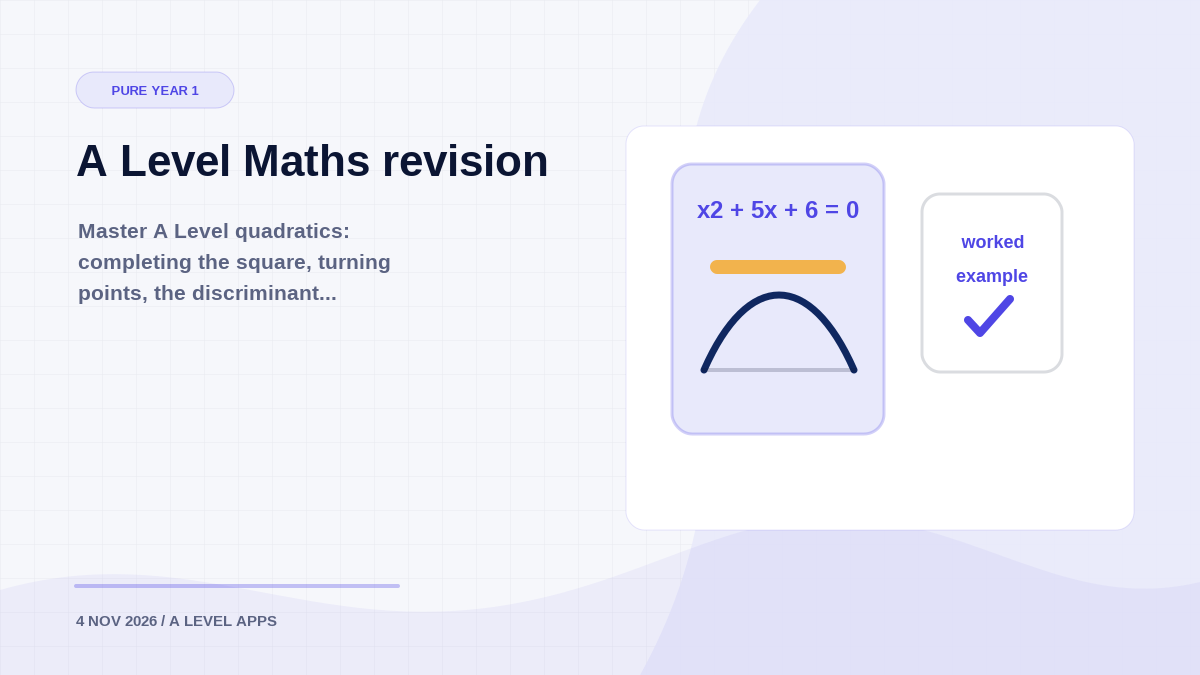
Quadratics can look like a GCSE topic carried over to A Level. You’ve factorised trinomials and used the quadratic formula before. But Pure Year 1 uses the topic in new ways. Completing the square becomes a way to find turning points, the discriminant turns up in “find the value of k” and proof questions, and quadratics come back in disguise in exponentials, trigonometry and mechanics.
This guide goes through each idea with worked examples, and points out where marks are usually lost.
Completing the square and turning points
Completing the square writes a quadratic in the form a(x + p)² + q. In this form you can read off the turning point straight away: (−p, q).
When the x² coefficient is 1, halve the x coefficient, then subtract that number squared:
y = x² + 8x + 5 = (x + 4)² − 16 + 5 = (x + 4)² − 11
A squared term can never be negative, so (x + 4)² is at least 0. Its smallest value is 0, when x = −4. So the minimum value is −11, when x = −4, and the turning point is (−4, −11).
When the coefficient isn’t 1, factor it out of the first two terms only:
2x² + 12x + 3 = 2(x² + 6x) + 3 = 2[(x + 3)² − 9] + 3 = 2(x + 3)² − 15
The minimum value is −15, when x = −3.
When the coefficient is negative, the method is the same, but take extra care with signs:
−x² + 4x + 1 = −(x² − 4x) + 1 = −[(x − 2)² − 4] + 1 = −(x − 2)² + 5
This graph is an ∩ shape, so it has a maximum value of 5, when x = 2. Any other value of x takes a positive amount away from 5.
Tip: Don’t divide the whole expression by the coefficient when you’re rewriting a function. That changes the function. You can only divide through when you have an equation equal to zero.
Practise this on the completing the square page. Then check your answers by sketching the curve. The quadratic graphs page shows how the turning point, the y-intercept and the roots fit together.
Three ways to solve a quadratic equation
| Method | Best when | Watch out for |
|---|---|---|
| Factorising | The roots are whole numbers or simple fractions | Write “x = 5 or x = −3”, not “and” |
| Completing the square | The question asks for it, or you want exact surd answers | Remember the ± when you square root |
| Quadratic formula | Anything that doesn’t factorise | The formula isn’t in your booklet |
To solve by completing the square, first divide through if you need to (here you can, because it’s an equation):
x² − 6x + 4 = 0 (x − 3)² − 9 + 4 = 0 (x − 3)² = 5 x − 3 = ±√5 x = 3 ± √5
The quadratic formula, x = (−b ± √(b² − 4ac)) / 2a, should be second nature. Many key results like this one aren’t given in the exam. Our guide to formulae to memorise lists the others.
Exam tip: Your calculator’s equation solver is allowed unless the question says “show that” or names a method. If it does, write out every line of algebra. You can still use the calculator to check the roots you’re working towards.
Try some free questions: solving quadratic equations.
Quadratics in disguise
Some equations become quadratics after a substitution. Look for one power that is double another.
Example 1: x⁴ + 3x² − 4 = 0
Let y = x². Then y² + 3y − 4 = 0, so (y + 4)(y − 1) = 0, which gives y = −4 or y = 1.
Now substitute back. x² = 1 gives x = ±1. x² = −4 has no real solutions, because no real number squares to give a negative.
Example 2: 2^(2x) − 2^x − 2 = 0
Since 2^(2x) = (2^x)², let y = 2^x. Then y² − y − 2 = 0, so (y − 2)(y + 1) = 0.
2^x = 2 gives x = 1. 2^x = −1 is impossible, because an exponential graph always stays above the x-axis.
The most common mistake is to stop at the y values. The question asked for x, so always substitute back. The second example also depends on the index laws, so if you’re unsure about them, warm up with laws of indices. Then move on to quadratics in disguise.
The discriminant
The discriminant is the part of the quadratic formula under the square root: b² − 4ac.
| Discriminant | Roots | Graph |
|---|---|---|
| b² − 4ac > 0 | Two distinct real roots | Crosses the x-axis twice |
| b² − 4ac = 0 | One repeated root | Touches the x-axis (the axis is a tangent) |
| b² − 4ac < 0 | No real roots | Doesn’t meet the x-axis |
“Find the value of k”
Given that f(x) = kx² + 4kx + 3 has a repeated root, find the value of k.
Here a = k, b = 4k and c = 3. A repeated root means b² − 4ac = 0:
16k² − 12k = 0 4k(4k − 3) = 0 k = 0 or k = ¾
The question says “the value”, not “the values”, so look again at k = 0. That would make f(x) = 3, which isn’t a quadratic and has no roots at all. Reject k = 0. The answer is k = ¾. Saying why you’ve rejected a value is often worth a mark.
When the condition is “no real roots” or “two distinct roots”, you get an inequality instead. For example, x² + kx + 9 = 0 has no real roots when k² − 36 < 0, which means −6 < k < 6. That’s why this topic leads straight into quadratic inequalities.
Discriminant proofs
Prove that x² + (k + 2)x + k = 0 has two distinct real roots for all real values of k.
b² − 4ac = (k + 2)² − 4k = k² + 4k + 4 − 4k = k² + 4
Then explain why that’s positive. Since k² ≥ 0 for all real k, k² + 4 ≥ 4 > 0. So the discriminant is always positive, and the equation always has two distinct real roots.
That last sentence is not optional. Proof questions need a concluding statement. For more practice at setting out arguments like this, see proof by deduction. You can explore the topic further on the discriminant page.
Choosing the right form for modelling
Picking the right general form of a quadratic can save a lot of algebra:
- y = ax² + bx + c: the general form. c is the y-intercept.
- y = a(x − p)(x − q): use this when you know the roots p and q.
- y = a(x − p)² + q: use this when you know the turning point (p, q).
Don’t drop the a from any of these forms. Lots of different parabolas share the same roots or the same turning point. The a sets how steep the curve is, and its sign tells you whether it’s ∪-shaped or ∩-shaped.
Worked example: a thrown ball
A ball is thrown from a point 2 m above the ground. It reaches its maximum height after travelling 4 m horizontally, and it is 5 m high when it has travelled 6 m horizontally. Model its path as a quadratic.
The turning point is at x = 4, so use y = a(x − 4)² + c.
- At (0, 2): 16a + c = 2
- At (6, 5): 4a + c = 5
Subtracting the second equation from the first gives 12a = −3, so a = −¼ and c = 6. The model is:
y = −¼(x − 4)² + 6
a is negative, as you’d expect for a thrown ball, and the maximum height is 6 m. To find where the ball lands, set y = 0:
(x − 4)² = 24 x = 4 ± 2√6
Reject the negative root, because it describes the ball going “backwards” from where it was thrown. The ball lands 4 + 2√6 ≈ 8.90 m away horizontally.
This question needs simultaneous equations as well. It could also ask you to criticise the model, so it’s worth knowing common modelling assumptions, such as ignoring air resistance or treating the ball as a particle.
Common mistakes to avoid
- Losing the ± when you square root both sides.
- Dividing a function by its x² coefficient instead of factoring the coefficient out.
- Giving y values when the question asked for x in a disguised quadratic.
- Forgetting to reject values like k = 0, or impossible results like 2^x = −1.
- Missing the concluding sentence in a discriminant proof.
If the step up from GCSE algebra feels steep, our guide to the GCSE to A Level jump has advice on building fluency quickly.
Practise quadratics with the app
Quadratics come up again throughout the course. You’ll use them in differentiation, trigonometric equations, kinematics and more, so time spent getting them secure now pays off later. The A Level Maths app has revision notes, worked examples and exam-style questions for every quadratics subtopic, matched to Edexcel, AQA, OCR A or OCR B (MEI). Each answer comes with an explanation, so you can see where a mistake came from.
You can start free: the quadratics topic has notes for every subtopic, and the free practice questions are a good place to test yourself before you open a past paper.
Frequently asked questions
How do you complete the square when the x² coefficient isn't 1?
Factor the coefficient out of the x² and x terms only, and leave the constant outside the bracket. Complete the square inside the bracket, then multiply back out and simplify. For example, 2x² + 12x + 3 = 2(x² + 6x) + 3 = 2[(x + 3)² − 9] + 3 = 2(x + 3)² − 15.
What does the discriminant tell you about a quadratic?
The discriminant is b² − 4ac. If it is greater than 0 the quadratic has two distinct real roots. If it equals 0 there is one repeated root, and the graph touches the x-axis. If it is less than 0 there are no real roots, and the graph doesn't cross the x-axis at all.
Can I use my calculator to solve quadratics in A Level Maths?
Yes, unless the question says 'show that' or asks you to use a particular method, such as completing the square. In those cases you have to show the full algebra. You can still use your calculator to check your answer.
Is the quadratic formula in the A Level formula booklet?
No. You're expected to know the quadratic formula from GCSE, so learn x = (−b ± √(b² − 4ac)) / 2a by heart. The same goes for the discriminant b² − 4ac.
What is a quadratic in disguise?
It's an equation that becomes a quadratic after a substitution. Examples are x⁴ + 3x² − 4 = 0, where you let y = x², or 2^(2x) − 2^x − 2 = 0, where you let y = 2^x. Solve for y, substitute back, and reject any values that are impossible, such as x² = −4 or 2^x = −1.