Edexcel vs AQA vs OCR A vs MEI: How A Level Maths Differs by Board
· Webrich Software · 6 min read
If you’ve ever used a revision resource written for a different exam board, you’ll know the worry: is this actually on my course? For A Level Maths the reassuring answer is that the content is almost entirely the same. What differs is how it’s examined — and those differences are worth knowing.
This guide covers the four main specifications taken in England: Pearson Edexcel, AQA, OCR A and OCR B (MEI).
Same content, different exams
The subject content for A level Mathematics is set by the Department for Education, and every board’s specification has to cover it. So Pure Mathematics, Statistics and Mechanics are on every course, and topics such as proof, the binomial expansion, calculus, hypothesis testing and projectiles appear on all four.
Two other things are common to all boards:
- Calculators are allowed on every paper, and you’re expected to use one with statistical functions.
- Every course includes a Large Data Set, and the exams assume you have used it.
So where do the boards differ? In four places: the paper structure, the Large Data Set, the formula booklet, and the style of questions.
Specification codes
| Board | A level | AS |
|---|---|---|
| Pearson Edexcel | 9MA0 | 8MA0 |
| AQA | 7357 | 7356 |
| OCR A | H240 | H230 |
| OCR B (MEI) | H640 | H630 |
The code is printed on the front of every past paper, which is the quickest way to check that a paper is the right one for you.
Paper structure
All four boards set three papers at A level, but they split the applied content differently.
| Board | Paper 1 | Paper 2 | Paper 3 |
|---|---|---|---|
| Edexcel | Pure Mathematics 1 | Pure Mathematics 2 | Statistics and Mechanics |
| AQA | Pure | Pure and Mechanics | Pure and Statistics |
| OCR A | Pure Mathematics | Pure Mathematics and Statistics | Pure Mathematics and Mechanics |
| MEI | Pure Mathematics and Mechanics | Pure Mathematics and Statistics | Pure Mathematics and Comprehension |
Edexcel, AQA and OCR A papers are each 2 hours long and worth 100 marks.
What this means for revision:
- Edexcel keeps Pure and applied separate. Papers 1 and 2 are entirely Pure, and Paper 3 is split into a Statistics section and a Mechanics section.
- AQA, OCR A and MEI mix Pure into every paper, so Pure questions can appear alongside Statistics or Mechanics.
- MEI’s Paper 3 includes a comprehension task — reading an unfamiliar piece of mathematics and answering questions about it. Practise this specifically; it’s unlike anything on the other boards.
The Large Data Set
Each board picks its own real-world data set:
| Board | Large Data Set |
|---|---|
| Edexcel | Met Office weather data from UK and overseas stations, 1987 and 2015 |
| AQA | Department for Transport data on cars registered in 2002 and 2016 |
| OCR A | Census data for England and Wales, 2001 and 2011 |
| MEI | Rotates: a health survey sample for A level exams in 2027, countries data from 2028 |
Because exam questions rely on familiarity with the context, revising the wrong data set is one of the few ways a board mix-up can really cost you. We’ve written a full guide to each Large Data Set.
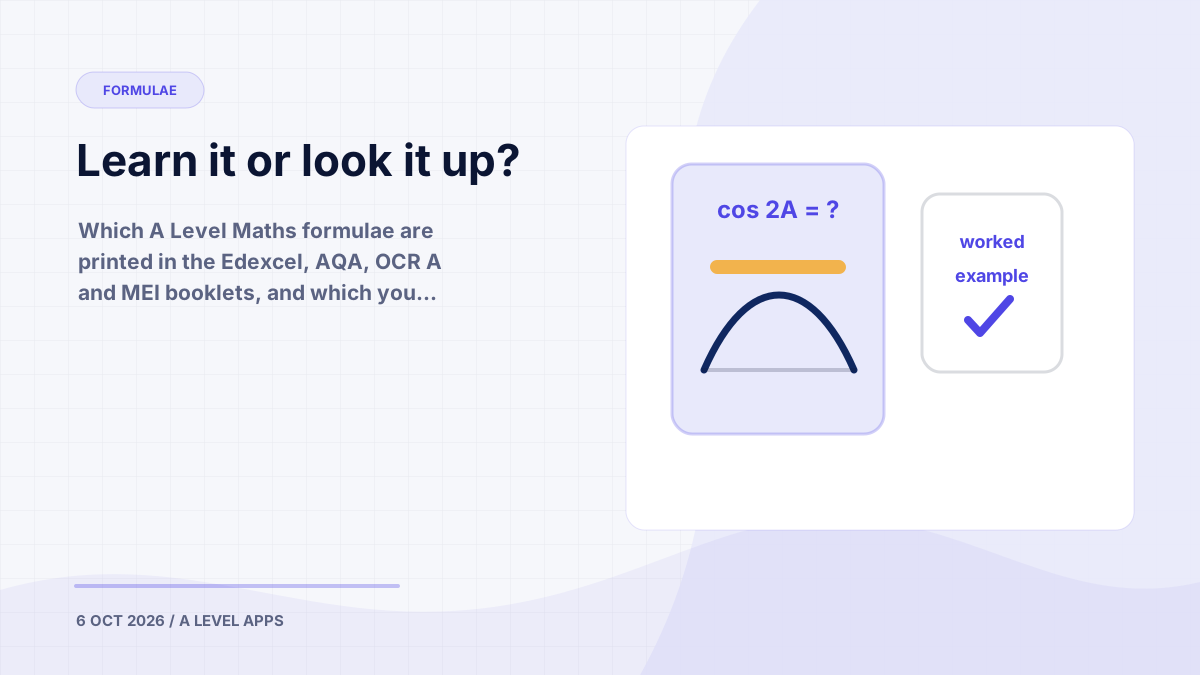
The formula booklet
Every board provides a formula booklet, but they’re not identical. All four print the compound angle formulae, the quotient rule, integration by parts, the trapezium rule, Newton–Raphson, the series sums and the suvat equations. None prints the quadratic formula, the chain rule, the product rule or the double angle formulae.
In between, there are real differences. A few examples:
- Only Edexcel prints the change of base rule for logarithms and the integrals of tan kx, cot kx, sec kx and cosec kx.
- AQA, OCR A and MEI print ∫ f′(x)/f(x) dx = ln|f(x)| + c; Edexcel doesn’t.
- OCR A and MEI print the conditional probability formula; Edexcel and AQA don’t.
- MEI doesn’t print the binomial variance np(1 − p); the other three do.
- AS candidates on OCR A and MEI get a much shorter formula page than the full booklet.
Our formulae page lets you pick your board and see which cards are “In your booklet” and which you need to learn, and our formulae guide covers the main differences.
Style and emphasis
With the same content, it’s natural for boards to differ in emphasis and in how questions are worded. A few practical examples from building board-specific topic trees for our app:
- Coding of data (transforming x to y = (x − a)/b) appears as its own subtopic for Edexcel and MEI students.
- Percentiles and interpolation from grouped data get extra attention for Edexcel.
- MEI students get a subtopic on types of data and the shape of distributions.
- Rods and ladders problems in moments are included for Edexcel, AQA and OCR A.
These are small differences, but they’re exactly the kind of thing that makes a generic revision resource feel slightly “off” for your course.
AS level: a separate qualification
AS Mathematics is a standalone qualification. Since the reforms, AS results no longer count towards the full A level, so students taking the A level sit all their A level papers at the end of the two-year course, whatever they did in Year 12.
The AS content is a subset of the Year 1 content — mostly Pure Year 1, plus the first parts of Statistics and Mechanics. That’s why topics such as the Normal distribution, projectiles and everything in Year 2 Pure are A level only.
If you’re taking AS:
- use the AS specification code (8MA0, 7356, H230 or H630) when you look for past papers
- check your formula page carefully — OCR A and MEI AS candidates get a shorter one
- make sure your revision resource hides the A level-only content, so you don’t spend time on topics that can’t come up
Does it matter which board you’re on?
You usually don’t choose — your school or college does. But it matters a great deal that your revision matches your board:
- Past papers are the single best revision resource, and they need to be your board’s.
- The Large Data Set is completely different for each board.
- The formula booklet decides what you need to memorise.
- Paper structure affects how you practise: Edexcel students can do a pure-only mock; AQA, OCR A and MEI students should practise switching between Pure and applied questions within a paper.
Watch out: OCR has two A Level Maths specifications. OCR A (H240) and OCR B, known as MEI (H640) have different papers, different Large Data Sets and different formula booklets. Make sure you know which one you’re taking.
Revising for your board
The A Level Maths app asks for your board and course (AS or A level) when you first open it. From then on, every topic, Large Data Set section, mock test and formula card follows that choice, so you only revise what your exams test — and you can switch board at any time in Settings. Browse the topics for any board on this site, or try the free questions first.
Frequently asked questions
Is one exam board easier than another?
Not in any useful sense. The content is set nationally and grade boundaries are adjusted so that grades mean the same across boards. What matters is preparing for your own board's papers, booklet and Large Data Set.
How do I find out which board I'm taking?
Ask your teacher or look at a past paper your school has given you — the board and the specification code (for example 9MA0, 7357, H240 or H640) are on the front.