How to Make an A Level Revision Timetable You'll Actually Stick To
· Webrich Software · 6 min read
Most students have made a revision timetable at some point. It usually looks great on day one: colour-coded, every hour filled, three subjects a night. By day three it’s been abandoned.
That isn’t laziness. A timetable that only works on days when you feel motivated is a badly designed timetable. The aim is a plan that still works on your worst days: tired after a long day of lessons, behind on homework, not in the mood.
This guide covers two kinds of plan, because they do different jobs:
- School days, where the goal is consistency
- Weekends and holidays, where the goal is progress
Part one: school days
By the time you get home, you’ve already spent most of your mental energy in lessons. If your timetable says “revise for three hours after school”, failing to do that doesn’t mean you lack discipline. It means the plan was unrealistic.
So for school days the rule is: flexible in time, fixed in action. You don’t commit to a time on the clock. You commit to exactly what you’ll do once you sit down.
Rule 1: anchor sessions to events, not clock times
“I’ll start at 6pm” tends to go wrong. It gets to 6:05, you decide to start at 6:30, and the evening slips away.
Instead, tie your study block to something that already happens every day:
- after you get home and have a snack
- after dinner
- after you finish that day’s homework
- before you shower
“After dinner, I do one study block” needs no decision and no willpower to begin. The dinner is the trigger.
Rule 2: one short block, and you’re allowed to stop
On a school day you need one focused block of 60–90 minutes. Not three subjects. One block, which can be homework, revision or both.
The important bit: once that block is done, you’re allowed to stop. You can keep going if you feel like it, but you don’t have to. Studying that has a clear end is much easier to start than studying that feels endless.
Rule 3: move memorisation out of your desk time
A lot of A Level revision is memorisation: definitions, equations, reagents and conditions, formulae that aren’t in the booklet. You don’t need to sit at a desk for that.
Flashcards are portable, so use the dead time in your day: the bus, waiting for a lesson, the queue at lunch. Five or ten minutes at a time soon adds up, and your proper study block stays free for questions and harder thinking.
A few rules make flashcards work much better:
- Test yourself and don’t just flip. Say or write the answer before you turn the card over.
- Use spacing. Review cards just before you’d forget them, and see the ones you get wrong more often than the ones you know.
- Keep cards small. One fact or one equation per card.
Good candidates for cards include the Maths formulae you have to learn (our guide to what to memorise and what’s in the booklet helps here), the equations on the Physics formula cards, and the Chemistry formula cards for calculations such as moles and concentration.
Rule 4: decide the task in advance
You should never sit down and think “what shall I do?” Making that decision every night costs energy and usually ends with you doing whatever feels easiest.
Your timetable should give each day a category, so it’s specific enough to act on but loose enough to adapt:
| Day | Study block (after dinner, 60–90 minutes) |
|---|---|
| Monday | Maths: exam questions on this week’s topic |
| Tuesday | Chemistry: this week’s topic review, then homework |
| Wednesday | Physics: homework, then 15 practice questions |
| Thursday | Weakest subject: one red topic, notes then questions |
| Friday | Light: go through this week’s mistakes, or rest |
| Weekend | See part two |
The exact task can change with your homework load, but the category stays the same. That’s how a plan stays both flexible and fixed.
Tip: “Revise chemistry” is too vague to start on. “Answer the free questions on moles, particles and molar mass and write down why I got each wrong one wrong” is a task you can begin in ten seconds.
Rule 5: the plan is a default, not a prison
If you miss a day, don’t panic and don’t try to make up the hours. Just do the normal block the next day. One good block every day beats five hours once a week, because consistency matters more than intensity.
Part two: weekends and holidays
On weekends and in the holidays you have time, which is exactly when plans tend to go wrong. Students either do nothing all day or plan eight hours and burn out by lunchtime.
The rule here is a few sessions, done well, each with a clear purpose.
Rule 1: plan sessions, not hours
“I’ll revise all Saturday” means nothing. Plan two to four sessions of 60–90 minutes, each focused on one thing. When they’re done, you’re done for the day. This guards against burnout and procrastination at once.
Rule 2: give every session a theme
School-day blocks keep things ticking over. Weekend sessions are where you fix weaknesses and get ahead, so each one needs a purpose:
- Maths: a timed section of a past paper
- Physics: a weak topic from scratch, such as SI base and derived units, and then harder questions
- Chemistry: a full topic, notes first and then exam questions
When you know what a session is for, it’s much easier to get started.
Rule 3: do the hard work first
Your energy is highest early in the day, even if you’re not a morning person. Put the hardest task first, the medium task next and the easiest review last.
If you do it the other way round, you’ll arrive at the hardest work with the least energy, and that’s when procrastination wins.
| Session | Difficulty | Example |
|---|---|---|
| 1 (morning) | Hard | Past-paper questions on your weakest topic |
| 2 (late morning) | Medium | New topic notes, then practice questions |
| 3 (afternoon) | Easy | Flashcards and mistakes-log review |
Rule 4: leave gaps on purpose
A weekend plan with no empty space will fall apart the first time something takes longer than expected or a friend asks you out. Build in free time, including time for things you enjoy. A good timetable expects things to go wrong.
Rule 5: pick your one big win
At the start of each weekend, ask yourself: “If I only get one thing done this weekend, what would actually matter?”
Maybe it’s finally understanding differentiation from first principles, or finishing a full physics paper. That’s your anchor, and everything else is a bonus. Oddly, taking that pressure off usually means you get more done.
Putting it together
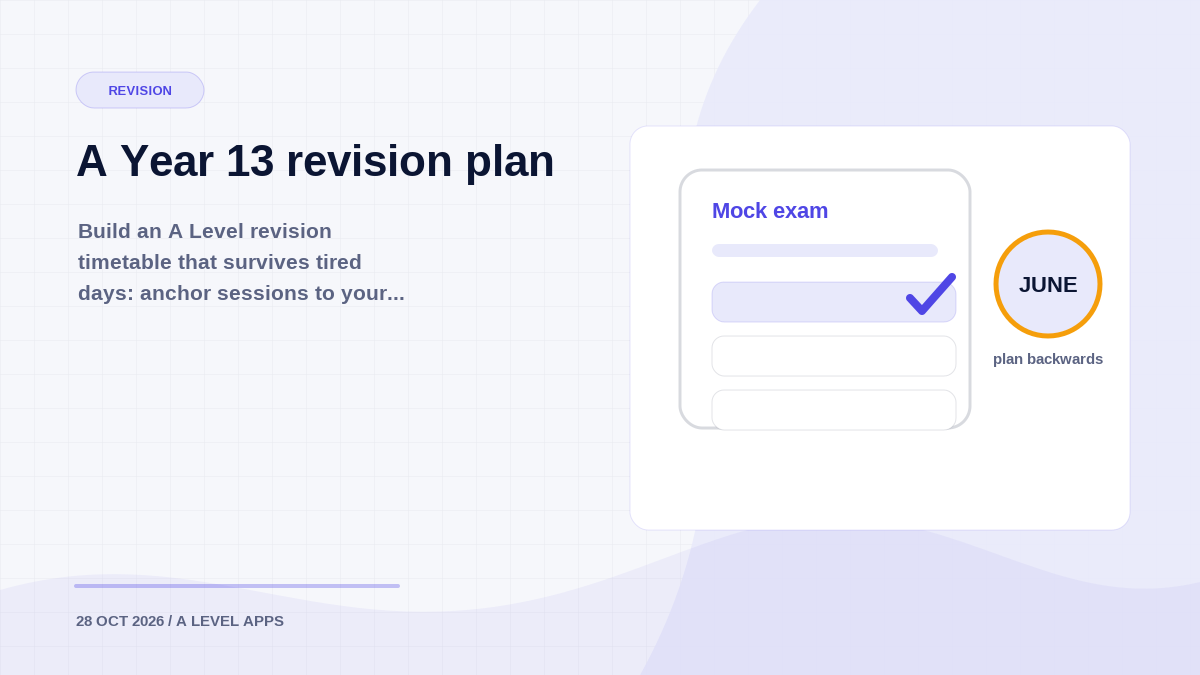
If you’re in Year 12, the GCSE to A Level jump is the reason to set up this habit early: the content builds on itself, and small, regular sessions stop gaps from opening up. In Year 13, the same structure fits into a longer plan. Our Year 13 revision plan is written for Maths, but the month-by-month approach works for any subject.
Start small. One anchored block tonight, with the task decided in advance. That’s a timetable you can keep to.
Using the apps with your timetable
The A Level Revision apps are made for short, focused sessions like these. Pick your exam board and you can open a topic, read the notes and answer exam-style questions in one block:
- A Level Maths: notes, worked examples and formula cards for Edexcel, AQA, OCR A and MEI, plus a mock test for every area
- A Level Chemistry: AQA and OCR A topic practice, worked notes and mixed mocks
- A Level Physics: AQA and OCR A questions with worked explanations, formula cards and paper-style mock exams
You can try them free on this site first. Browse the Maths, Chemistry or Physics topics, filter to your board, and pick tonight’s task.
Frequently asked questions
How many hours a day should I revise for A Levels?
On school days, one focused block of 60 to 90 minutes is enough for most students, plus a few short bursts of flashcards. On weekends and holidays, aim for two to four sessions of 60 to 90 minutes each. A short session done well is worth more than a long one you only half concentrate through.
Why do I always stop following my revision timetable?
Most timetables fail because they ask for too much: hours of study after a full school day, fixed clock times that slip, and no spare time when life gets in the way. A timetable that sets a small amount of work, ties sessions to things you already do, and leaves gaps on purpose is far easier to stick to.
Should I plan my revision by time or by task?
Plan by task. Something like 'after dinner: 20 chemistry calculation questions and check the mistakes' is much more useful than 'study 6pm to 8pm'. When you sit down, the decision is already made, so you can start straight away.
What should I revise first in a weekend session?
Do the hardest work first, while you have the most energy. That usually means exam questions on a weak topic. Leave easier tasks, like reviewing flashcards or reading back over notes, for later in the day.
Is it bad to miss a day of revision?
No. Your timetable is a default, not a contract. If you miss a day, just carry on the next day without trying to make it up. Keeping going matters far more than any single session.